
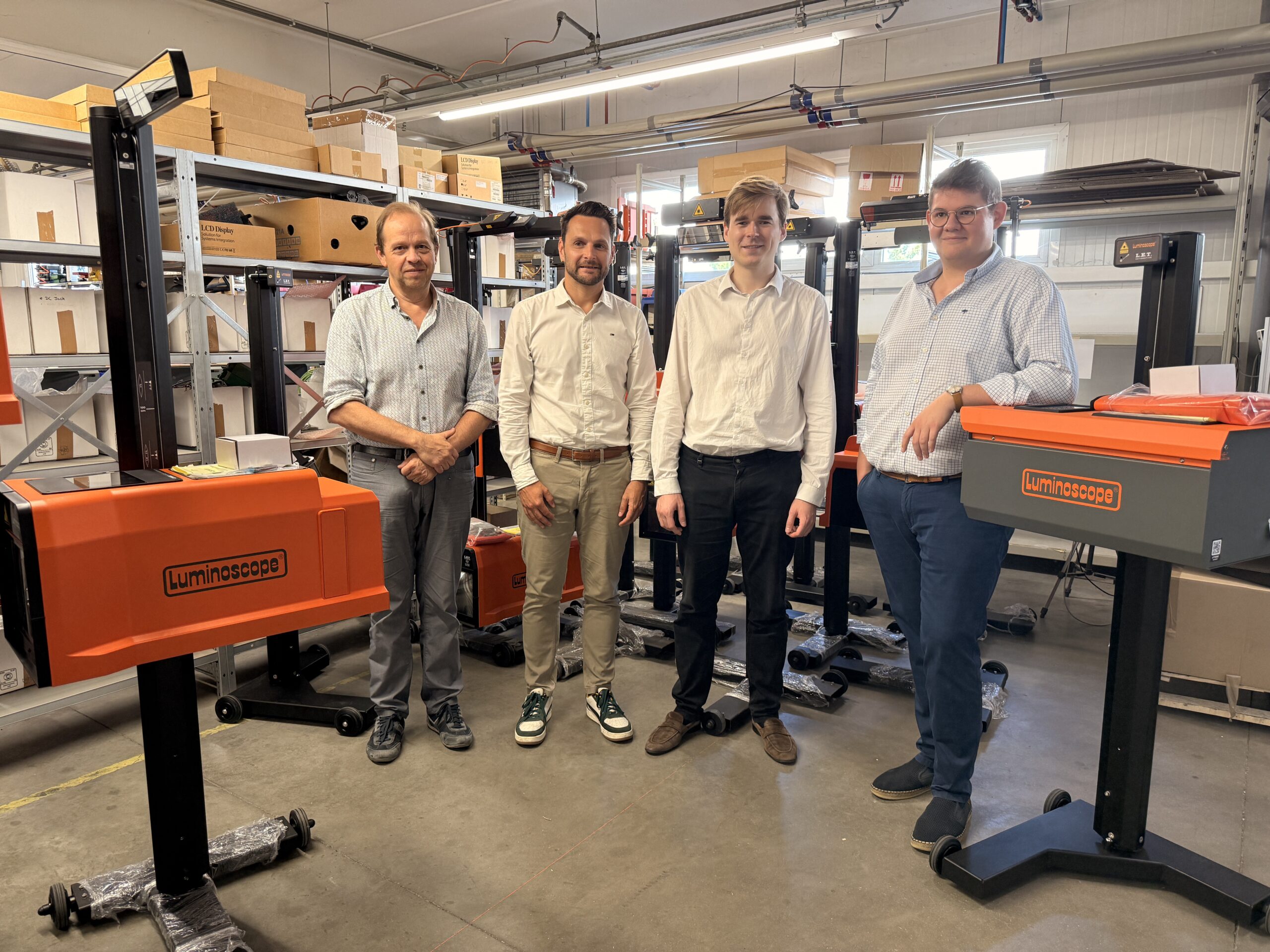
Today’s cars are packed with safety technology. Sensors, radars, and cameras monitor the surroundings and intervene or issue warnings in case of danger. The reliability of that data is therefore crucial, and it all starts with the precise alignment of these advanced driver-assistance systems. This is right up the alley of L.E.T. Automotive, which manufactures high-tech inspection and calibration equipment from its base in Deinze. They have the expertise in-house, but for the mechanical work, they also rely in part on ATS. It’s a story of co-creation aimed at developing even more effective solutions.
From our own optical components to measurement systems
L.E.T. Automotive was founded in ’67, long before advanced driver-assistance systems were even a concept. It began as the Laboratory for Electronic Applications. Those roots are still evident in the company’s name and in what it does. “Today, the group consists of three other companies, which together employ about 70 people: Deltro Systeemtechniek (measuring instruments for other sectors), L.E.T. Optomechanika (based in Prague, specializing in optomechanical components and optography), and E.T.S. (based in Bratislava, specializing in software). We have the expertise to develop our own optical components and then integrate them into vision and measurement systems. The starting point is always that “ electro ” optical precision for which we have built our reputation; it is the applications that differ, ensuring that every company within the L.E.T. Group remains very close to its customers. And we are also close to one another, as we share R&D to grow stronger together.”
Leading in Headlights
L.E.T. Automotive’s expertise is largely focused on headlights. Director Michael Vandewalle: “That’s what we really specialize in: how to adjust them, how to calibrate them, how to inspect them, … It’s also our approach to the entire lifecycle of headlights that makes us so strong. We focus on supporting headlight manufacturers. We then apply that accumulated expertise to installations at automakers and, of course, to the testing and calibration of headlights at vehicle inspection stations and auto repair shops. The equipment we build for garages and vehicle inspection stations is often more complex than the headlight adjustment systems used in factory settings, because these facilities handle a wide range of makes and models from all model years. This strong position makes us ideally suited to focus on all of the customer’s other technical requirements, including the development of the centering units we build for the automakers’ factories.” The list of brands is now impressive. It ranges from BMW, Tesla, and Volvo, to Toyota, Renault, Skoda, Polestar, and Rolls-Royce. L.E.T. Automotive has installations in 55 countries.
Customization
From headlights, it’s actually just a small step to ADAS (advanced driving assistance systems) such as adaptive cruise control, lane-keeping assist, and traffic sign recognition. “In production, those adjustments are often made right after one another. That’s how we got into it, so to speak,” says Vandewalle. Every unit that L.E.T. Automotive builds is custom-made. “It’s not that we have to start from scratch every time, but each brand has its ADAS technology located slightly differently because the cars’ chassis are different. Moreover, we try to cover the widest possible range of models for our customer with a single workstation. That’s not always easy when you consider that these models can sometimes differ by several meters,” explains Yves Pinoy, Head of R&D – Project Development.
Co-creation Close to Home
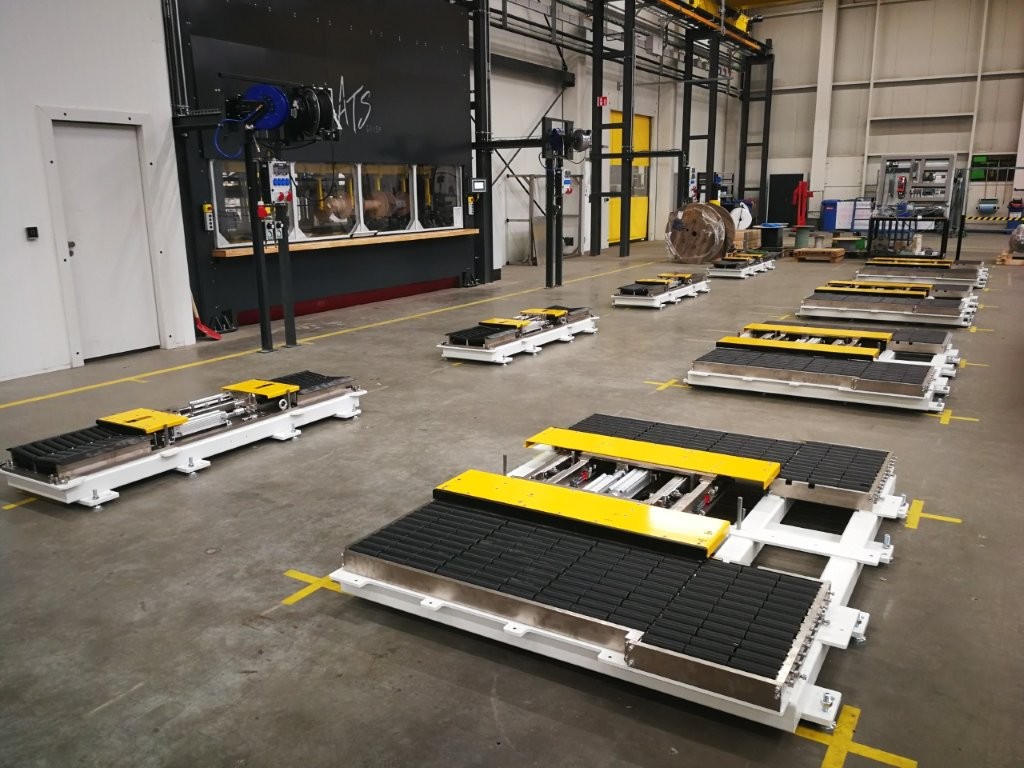
“At the time, we were working with a German partner. However, we were looking for expertise closer to home—a partner who speaks the same language, both literally and figuratively. Above all, we wanted a partner with a team that could truly bounce ideas off of us to help us keep improving,” Sergeant continues. With its first project for BMW China, ATS proved it could handle the tight deadlines and precision requirements set by the automotive industry. The assignment was clear: to develop and produce a heavy-duty, corrosion-resistant version of the centralizers that had already been manufactured in the past. ATS project manager Yves De Clerck cites one of the improvements as an example: powder coating. “The black color must have the perfect gloss level to prevent any reflections. This is monitored very strictly. Furthermore, in consultation with L.E.T., we opted to electroless nickel-plate the bare steel parts to achieve the necessary corrosion resistance.” In subsequent orders, ATS’s ability to think proactively became increasingly evident. Pinto: “The foundation, of course, remains the design work from L.E.T. Automotive, but we now have a smooth back-and-forth process to reach a final consensus.” In other words, co-creation. “This is an absolute added value, because they also bring experience from other projects,” explains Pinoy.
Continuing to Grow
For example, the recent centering systems built for BMW received an upgrade. Pinoy: “On the one hand, to keep pace with developments in the vehicles themselves. They’re getting heavier and heavier. With the new stainless steel rollers, we can handle up to 4.5 metric tons. On the other hand, to make them more robust. By using a fixed photocell—without the need for a reflector—we’re achieving a ‘quality of life’ improvement, so people can’t trip over it or drive into it,” he explains by way of example. Or something as simple as confirmation that the vehicle is properly centered. “You install a switch that’s pressed when the car is perfectly aligned with the tire. But you have to account for differences in wheelbase between models, so the system you design must also function with every wheelbase.”
Complexity
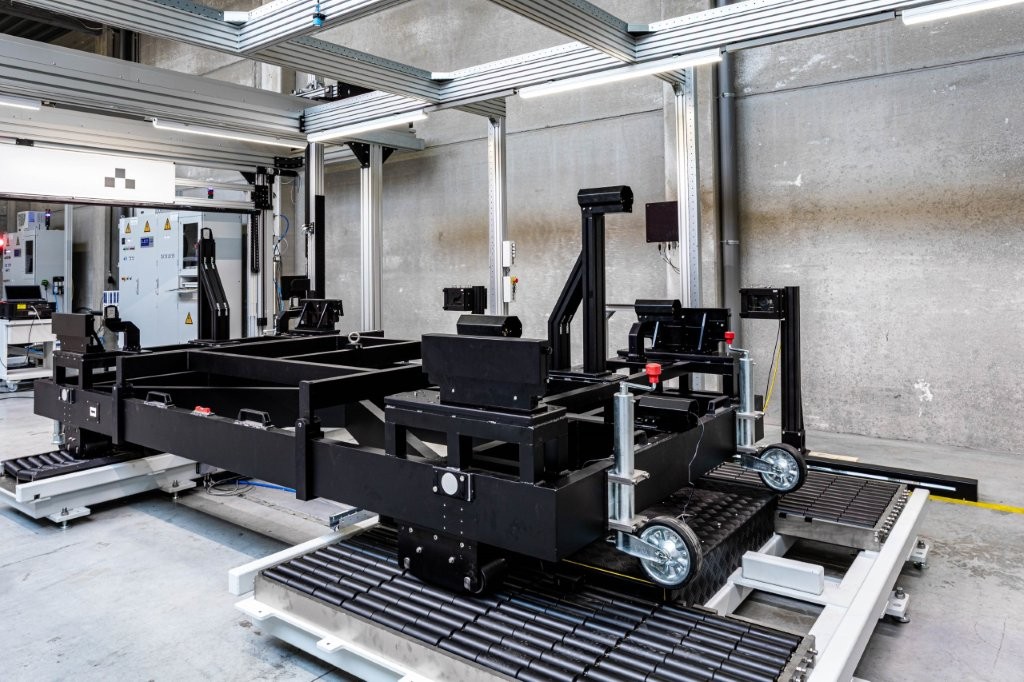
Project Manager Thomas Van Parys shows us what the latest system looks like. The car drives onto a seemingly simple-looking black platform. Sensors and other advanced instrumentation are mounted on the aluminum portal structure surrounding it. First, four cameras precisely measure the height of the wheel wells. The target then moves vertically to the correct position determined by the measurement. This allows the headlights and ADAS systems to be perfectly calibrated. As mentioned, contrast is crucial here. Meanwhile, the video screen gives the green light. Everything is perfectly calibrated. The next car can come in. “The technology looks simple, but we’re actually doing very complex things. That complexity is especially evident in its integration into a factory environment, where a system must operate for years without failure—and all within the precision of a measuring device.”
Long-term
ATS handled the mechanical work (the centralizer) at its workshop in Langerbrugge. L.E.T. then adds its electronics and the gantry structures with targets at its assembly hall in Deinze. Teamwork, dreamwork? “Absolutely—we truly see this as a long-term partnership. Although our customers are based abroad, as a family business we remain deeply rooted in our local community. By collaborating with local manufacturing companies, by mentoring students from nearby schools during internships… the partnership with ATS fits perfectly into this,” says L.E.T. Pinto also sees a promising future in it. “Ultimately, you go through a learning curve with every client: you get to know their way of working and their needs better and better. You adapt your own processes accordingly. For example, we’ve invested in knowledge and resources to master aluminum welding for L.E.T. Automotive. We still see plenty of opportunities to continue growing together,” he concludes.
ADAS Calibration Stand
An ADAS calibration stand is used to adjust and calibrate a vehicle’s various sensors, including cameras and radars. This is done using various targets, which are automatically and precisely positioned around the vehicle.
In addition to the targets, the vehicle itself must also be correctly positioned and centered; the centralizer is used for this purpose. Next, the highest points of the four wheel wells are optically measured and transmitted to the customer’s control system. Based on this data, the system determines the vertical positions of the various targets.
For the lane departure warning camera, which is located behind the windshield, a panel with an optical pattern is precisely positioned in front of the vehicle. For the radars, which are located at the front and at the corners of the car, corner reflectors are placed in the correct positions.
Finally, the PAC-360 system, which generates a full top-down or helicopter view of the vehicle, is calibrated using ground panels with an optical pattern. Once all calibrations have been successfully completed, the vehicle can exit the ADAS calibration mode.


