
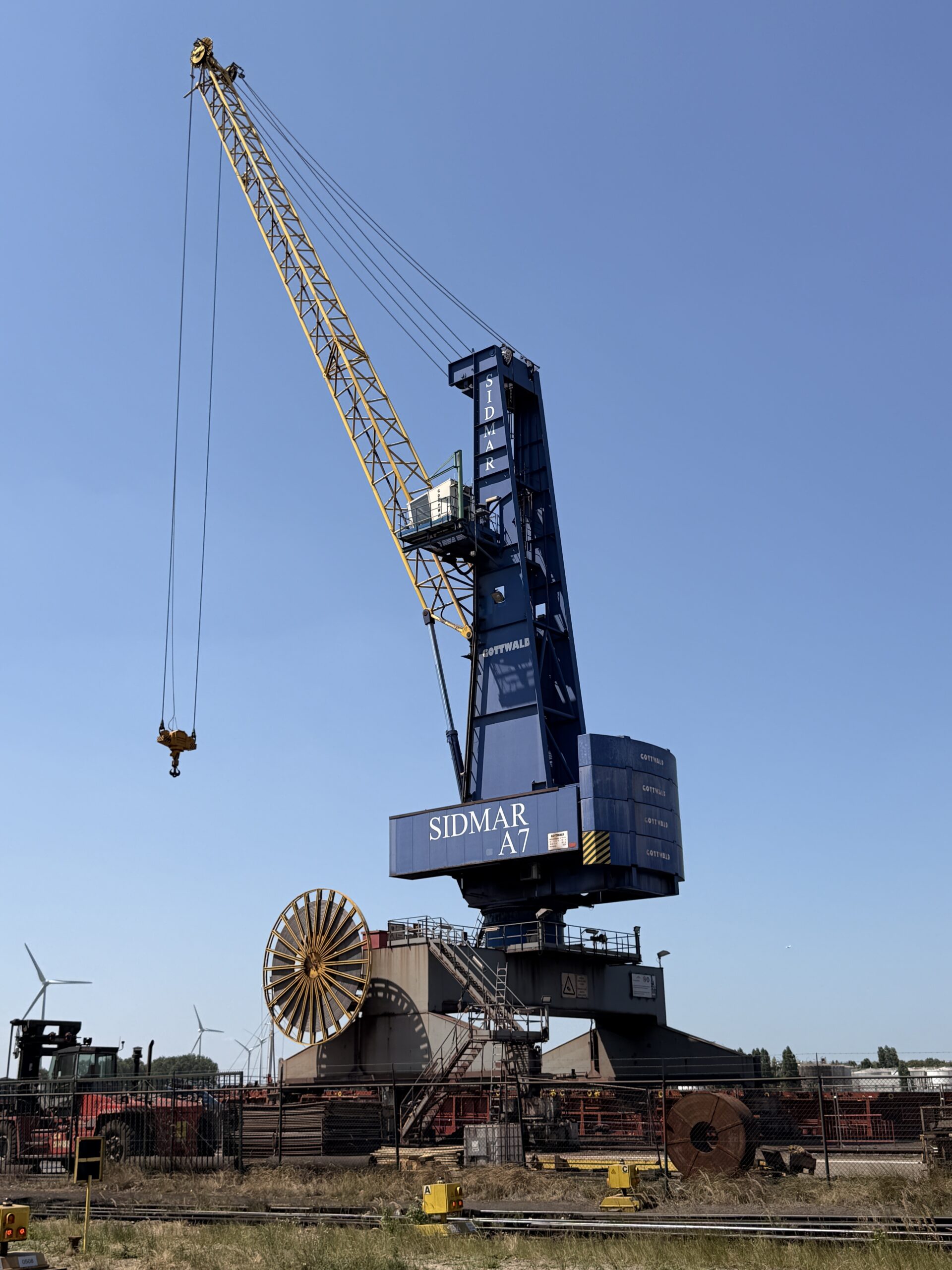
When a crane lifts loads weighing up to 65 metric tons, reliable and safe operation must be guaranteed. When the A7 crane on the canal quay in Gent-Terneuzen could no longer meet this requirement, ArcelorMittal Belgium opted for an electric conversion. Using Siemens technology, ATS ensured that it now operates better than ever before.
Raw Materials, Ports, and Transportation
ArcelorMittal Belgium operates a site in the Gent , covering nearly 100 hectares and employing approximately 5,000 people. Without strict organization, it would be absolute chaos there in the Ghent Canal Zone. The “Raw Materials, Port, and Transportation” department handles the bulk of transportation on the site. This includes, among other things, the ships that dock at the unloading piers and the trains and conveyor belts that crisscross the site. “We ensure that every department receives the right materials at the right time to guarantee production,” says Mario Minnaert, explaining in a nutshell what they do in the ‘Raw Materials, Port, and Transportation’ department. “Not everything goes directly into the blast furnace; some of it is delivered to our sinter and coke plant or to other departments, or returns to us from there for storage.” Minnaert is responsible for technical support. “I guide our suppliers through projects. On the one hand, to familiarize them with how we want to work here. On the other hand, to keep the knowledge gained from these projects in-house.”
Loading and unloading slabs and rolls
As you approach the part of the site that borders the canal, you can see four large gantry cranes towering above the buildings from a distance. “Actually, they’re converted container cranes,” Minnaert reveals. But today we’ve come for the ice-blue crane standing next to them: the A7. “A real harbor crane with a height of 30 meters. It unloads the raw material—coils and slabs—from the ships that dock, with weights that can reach up to 65 metric tons (per slab or coil).” The thick slabs are what come out of the blast furnace. These are then progressively rolled thinner in the hot-rolling and cold-rolling departments into coils, depending on the customer’s requirements. Minnaert: “The steel used in a car differs from the steel used to make a refrigerator. This ranges from the raw materials in the recipe to the subsequent processing steps. The goal is to produce the steel into finished products within an eight-week lead time.”
Reliability is no longer guaranteed
The A7 harbor crane has been used for loading and unloading slabs and coils since the 2000s. “They arrive or depart for other ArcelorMittal locations, or go directly from here to customers.” But the A7’s reliability has left much to be desired in recent years, and replacement parts were no longer available. “When a ship docks, it has to be able to leave again in no time; otherwise, it’s not worth it. In other words, it has to be fast, without compromising safety. That, too, became increasingly difficult, because there were hardly any operators left who knew how to operate the crane.” As a result, ArcelorMittal had to rent a mobile crane to take over the A7’s tasks. “And that comes with a hefty price tag,” Minnaert notes.
Electrical retrofit
Various options were examined, including whether the adjacent gantry cranes could take over its work or at least provide backup in emergencies. “But the A7 remains a key link here on the quay.” ArcelorMittal therefore wanted to convert the harbor crane to electric power. “So that it operates reliably, is easy to operate, and is easy to diagnose in case of problems,” Minnaert summarizes the goal. A comprehensive set of specifications was to lay the foundation for this. The crane’s original manufacturer recommended ATS for the project. “ATS has already carried out several crane revamps here in other departments to our great satisfaction. They offered a fair price and were able to meet our timeline. Moreover, there are advantages to working with a partner located right around the corner,” Minnaert points out, referring to the other side of the Canal— Gent-Terneuzen—where ATS is located just 6 km away as the crow flies.
Check 500 I/Os
For Minnaert, it marked the beginning of a particularly pleasant collaboration. He certainly repeated this at least three times during the conversation. What did he appreciate so much? “Thibau (Lavent, ATS project manager) and his team tackle things the way I like to tackle them myself: with thorough preparation and a very pragmatic approach when you run into problems. Because with a retrofit of this scale, you’re bound to encounter them without exception.” To give some context on the project’s scope, there were a total of about 500 I/Os involved. ATS combed through the schematics, cross-checked them against reality and current functionality, and relabeled every wire before incorporating them into an updated digital schematic. The entire document totaled more than 900 pages. In addition, two new DC drives were installed—one for hoisting and one for slewing—along with a SINAMICS S120 configuration for travel and a new PLC. The choice of Siemens was an obvious one for both ATS as the Solution Partner (see sidebar) and ArcelorMittal. “A control system that is well known within the company,” Minnaert explains. To improve reliability, ATS also installed seven additional control cabinets in advance, built by its BU Electrical Panels division. Among other things, these replaced small IP65 enclosures with connectors. ATS’s mechatronics division also built mounting brackets and support components to securely fasten everything in place.
Reverse engineering
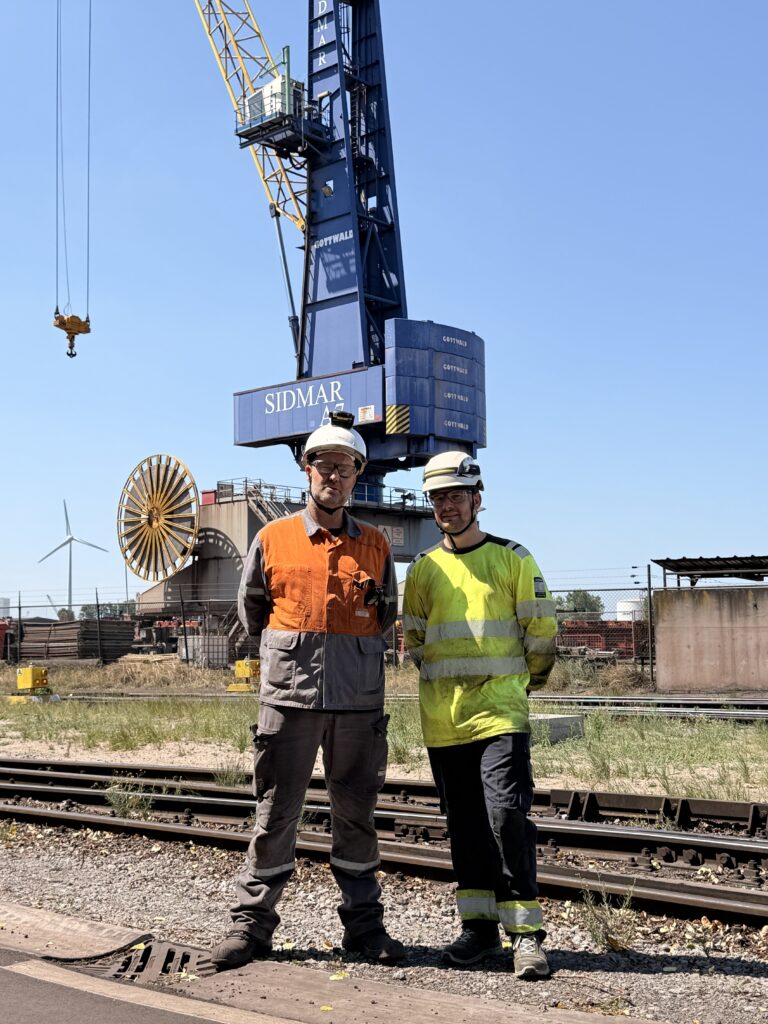
The actual conversion was scheduled for December and January and was expected to take five to six weeks. The plan called for two weeks of conversion, followed by connecting and testing everything. A 37-meter aerial work platform was set up next to the site to ensure safe working conditions. Despite the inclement weather, the ATS team got a head start on the schedule. They could certainly use that extra time to get the crane working perfectly again. “The biggest challenge was converting the existing PLC code to TIA Portal without having to rewrite everything,” says Lavent. “You can copy everything, but they’re essentially two different languages. To get that translation right, you have to do some reverse engineering so the crane can function exactly the same way again. But you always hit a snag somewhere during testing because not everything was exactly as it was on the original schematic.”
No more problems
Lavent: “For example, starting up the eight motors for crane operation took a little longer than expected. Based on the available schematics, we assumed they would operate at 400 V and 50 Hz. However, during the startup phase, we discovered that the motors were being operated at 87 Hz. Fortunately, we had already determined during the preparations that the existing variable-frequency drives were generously sized. That’s why we also opted for a generously sized drive, which in hindsight proved to be the right decision to allow the motors to operate smoothly at 87 Hz.”
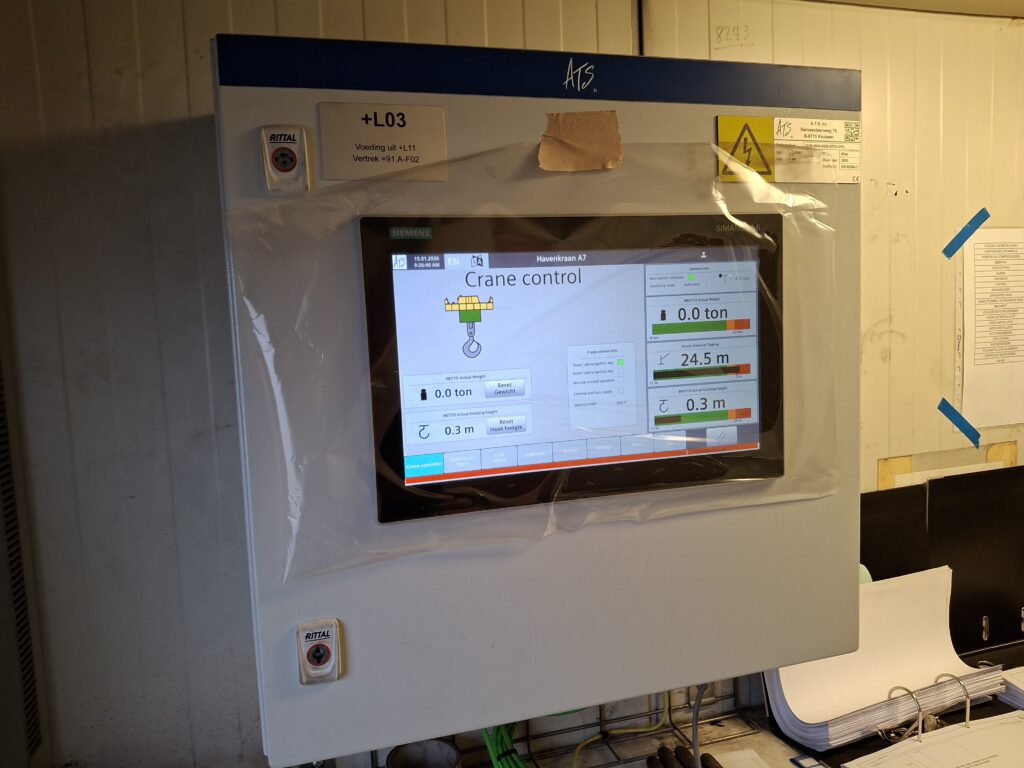
For Minnaert, the ATS team more than proved itself in these situations as a partner they could rely on. “Every problem was examined step by step, always in close consultation with us. You could tell right away that they knew what they were talking about. That expertise, combined with thorough preparation, was the key to success,” Minnaert is convinced. And it certainly was a success. Since the A7 harbor crane resumed operations this year, there have been no further problems. Operators can control the crane more easily than ever before—whether from the cab or the substation—using brand-new screens.
All-in-one software
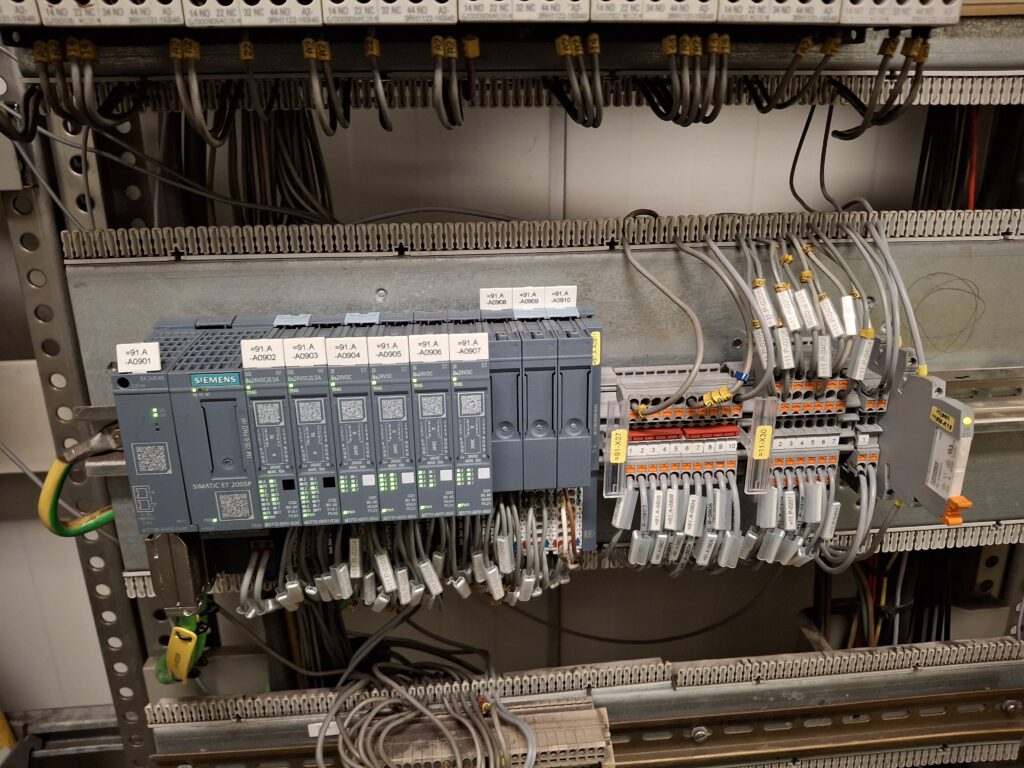
The A7 version 2.0 at ArcelorMittal Gent is a prime example of the power of a Siemens ecosystem. The drive technology (SINAMICS DCM and SINAMICS S120), automation (SINAMICS S7-1500F), network technology (SCALANCE W), electrification (SENTRON 3VA and 3WA), and software (TIA Portal) all work together in harmony in the upgraded harbor crane. “ATS developed an energy-efficient, safe, and user-friendly solution for ArcelorMittal,” says Siemens Partner Manager Jeroen Afslag. He points, among other things, to the regenerative operation of the drives and the integrated failsafe blocks within TIA Portal. “Thanks to end-to-end integration, everything fits into a single software platform, which makes it easy not only to develop the system but also to maintain it later on. As a loyal Siemens Solution Partner, ATS has all of this down to a fine art.” Still, this time they did reach out for technical support. “You don’t come across DC technology every day, especially on this scale. DC motors and drives are extremely robust and high-performing, but at the same time very complex. We then put ATS in touch with a Siemens expert who specializes in this field and has more than 25 years of knowledge and experience. Projects, no matter how technologically advanced they may be, still depend on people. It’s all about bringing the right team together to see them through to a successful conclusion,” concludes Afslag.
